
Search for a headshot pro today and you get two very different products: a photographer with a studio and a calendar, or an app that turns a dozen selfies into a set of generated portraits for the price of a takeaway lunch. They are not the same thing, and pretending otherwise helps nobody.
We shoot headshots for a living, so treat what follows with the appropriate scepticism. We have also looked closely at what these tools produce, and the honest answer is that AI headshots are genuinely useful in some situations and a bad idea in others. Here is where each wins, what the failure modes look like, and a simple way to decide.
What AI headshot tools actually do
You upload ten to thirty photos of yourself. The service fine-tunes a generative image model on your face, then produces dozens or hundreds of images of a person who looks broadly like you, in clothing you have never worn, in a room that does not exist.
The output is not a photograph of you. It is a new image built from a statistical impression of your face. That distinction sounds pedantic until you look at the hands.
Where AI headshots genuinely make sense
There are real cases. We would rather say so than pretend otherwise.
- A distributed team on a tight budget. Forty remote contractors across six time zones, an internal directory that currently shows grey silhouettes, and no budget to fly anyone anywhere. AI output beats grey silhouettes.
- You need something today. A conference programme closes at midnight and your only photo was taken at a wedding in 2019. An AI headshot buys you the deadline.
- Low-stakes internal use. Slack avatars, an intranet, a project wiki. Nobody is making a hiring or buying decision from these.
- A placeholder while you book properly. Perfectly reasonable. Just remember to replace it.
The pattern: the stakes are low, the audience is internal, or the timeline is broken. Those are legitimate constraints.
Where AI headshots fall apart
The artifacts, which are worse in the details than in the thumbnails
At 200 pixels on a phone, a good AI headshot passes. At full size, on a website bio, next to a real photograph, it usually does not. The recurring problems:
- Hands. Still the giveaway. A folded-arms pose produces thumbs in improbable places or a sixth finger that appears only when you zoom.
- Ears and jewellery. Earrings that merge with an earlobe, one stud where there were two, a chain that changes thickness partway around a neck.
- Hairlines and glasses. Edges are where these models struggle: frames that fuse into a temple, an arm that vanishes behind hair and never comes out, a hairline that looks airbrushed onto the forehead.
- Teeth and skin. Teeth come out slightly too uniform. Skin comes out slightly too smooth and evenly lit, with pores that read as texture rather than as skin. This is the source of the uncanny quality people notice but cannot name.
- Clothing that does not exist. Lapels that do not join, a collar that becomes a different collar behind the neck, buttons that stop halfway. Nobody consciously notices. Everybody registers something is off.
Retouching a real photograph and generating a face are different operations. The first removes a stray hair; the second invents an ear.
It is not actually you
This is the more serious issue, and it does not get better as the models improve. These tools converge on a symmetrical, well-rested, slightly younger version of a face. Fine in isolation. Then you walk into a meeting with a client who has been looking at that image for three weeks, and there is a small recalibration in the room. Not fraud. Just awkward, and awkwardness is the opposite of what a business portrait is for.
A headshot’s job is recognition and trust. Someone should be able to pick you out of a lobby. An image that flatters you into someone slightly different fails the only test that matters.
Regulated and relationship-based professions
In some fields the gap between the image and the person stops being awkward and starts being a professional problem.
Lawyers, physicians, dentists, realtors and financial advisors all work under licensing standards about not misleading the public. A generated portrait presented as a photograph of you sits in uncomfortable territory, and nobody wants to be the test case. Real estate is the sharpest example: a realtor’s face is on the sign, the card and the door, and clients meet it within a day.
If you work in one of these fields, our advice is simple: use a real photograph. We shoot lawyer headshots and realtor headshots in Vancouver, and the reason clients in those fields keep booking is not aesthetics. It is that a photograph is verifiable and a generated image is not.
The cost comparison, honestly
AI is dramatically cheaper, and anyone who tells you otherwise is selling something.
Most AI headshot services run somewhere between roughly $20 and $60 CAD for a batch of images. A professional session in Vancouver typically runs $200 to $600 CAD for one person; ours start at $350 CAD with high-end retouching, full commercial usage rights and a 48-hour turnaround. Our session pricing is published rather than quoted on request.
So the difference is roughly ten to twenty times. That is a real gap, and for someone earning nothing from their professional image it may be decisive.
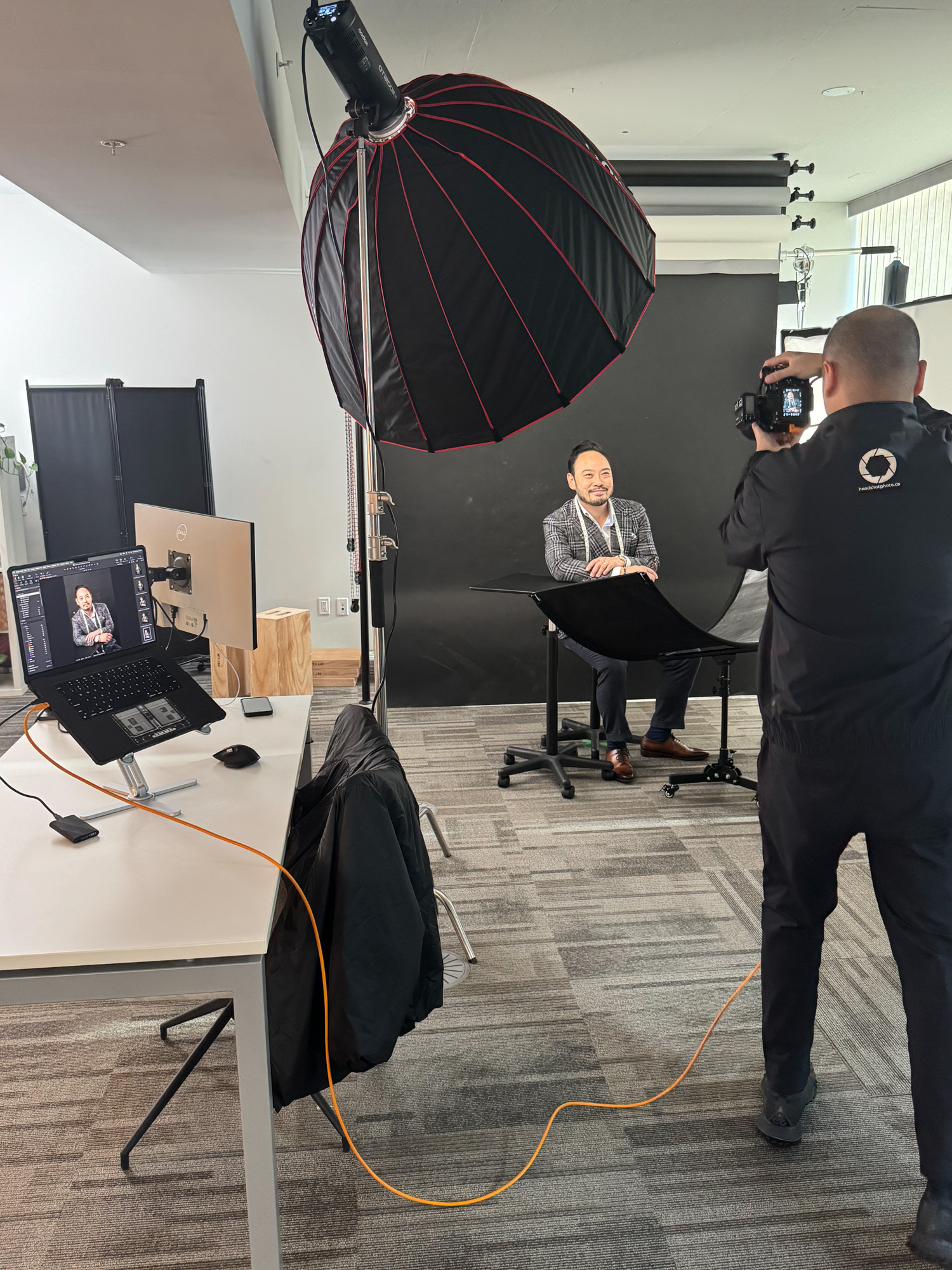
What the extra money buys, plainly: a photograph that is verifiably you, someone directing your expression and posture in real time, lighting chosen for your face rather than averaged from a dataset, and clear usage rights. We shoot tethered, so every frame appears on a large screen as it is taken and you choose your favourite before you leave. You are paying for certainty as much as craft.
One cost gets missed: a good headshot is used for three to five years across a website, LinkedIn, proposals and press. At $350 CAD over four years that is under $90 a year. Framed that way the gap narrows, though it does not close.
A decision framework
Four questions, in order. Answer them honestly and the choice usually makes itself.
- Will someone who sees this image meet me in person? If yes, use a photograph. This single question resolves most cases.
- Is a decision being made about me from this image? Hiring, buying, retaining, investing, casting. If yes, use a photograph.
- Does my profession have advertising or client-communication standards? If yes, use a photograph and do not spend an afternoon reading the rules to find a loophole.
- Is this internal, temporary, or genuinely low-stakes? If yes, AI is a reasonable answer, and you have saved yourself a few hundred dollars.
A practical middle path for teams: shoot the client-facing people properly and let everyone else use whatever they like. A partner-track lawyer and a backend developer do not have the same photo requirements.
Frequently asked questions
Can people actually tell an AI headshot from a real one?
Increasingly, yes, though usually not consciously. Anyone who looks at hundreds of profiles develops a fast intuition for too-smooth skin and slightly wrong background blur. Most viewers cannot name what is off, but they register it, and “something is off” is a poor first impression.
Is it against the rules to use an AI headshot on LinkedIn?
LinkedIn’s own terms require your profile to represent you accurately, and its photo guidance asks for a likeness of you rather than a logo, cartoon or someone else. Platform policies change, so check the current terms yourself. Beyond the rules, a profile photo that is not your face defeats the purpose of a network built on people recognizing each other. Our LinkedIn headshot sessions exist because that photo does real work.
Will AI headshots get good enough to replace photographers?
The artifacts will keep improving; hands are already better than they were. The identity problem does not improve with model quality, because it is not a rendering failure. A perfect image of a person who is not quite you is still not a photograph of you.
Can I use an AI headshot for an acting or on-camera profile?
No. Casting exists to match a real face to a real role, and submitting an image that does not match what walks into the room wastes everyone’s time. This is the least ambiguous case on the list.
Do you offer AI headshots?
No. We photograph people, in a studio in downtown Vancouver or on-site at your office. If AI is the right answer for your situation, use it with our blessing — we would rather you got a sensible outcome than an expensive one.
The short version
AI headshots are cheap, fast and adequate for low-stakes use. They are the wrong tool the moment someone is deciding something about you, or is going to meet you.
If your photo has a job to do, book a session and we will tell you straight whether you need one.
